
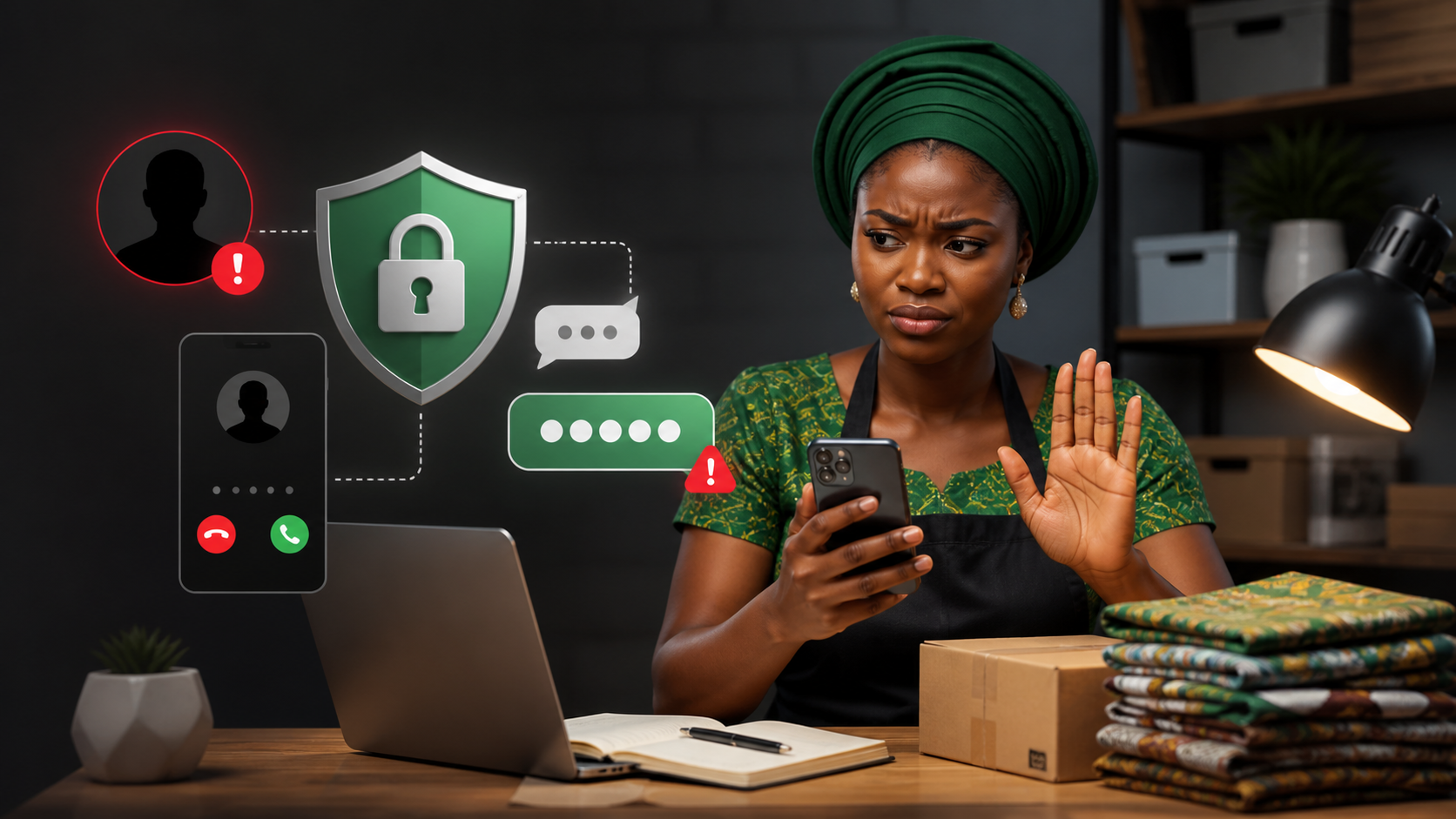
Scammers often ask sellers to share WhatsApp verification codes by pretending to be customers, delivery agents, or support staff. Here is how to avoid account takeover.
WhatsApp account hijack scams are simple because they target human trust, not advanced technology. A scammer may pretend to be a customer, delivery agent, group admin, friend, or support worker. Then they ask for a verification code.
If a seller shares that code, the scammer may register the account on another device and take over business conversations.
Why sellers are targeted
Nigerian online sellers depend heavily on WhatsApp. A hijacked account can affect orders, customer trust, payment discussions, delivery updates, and business reputation.
Scammers know sellers are busy. They may create urgency with messages like:
I sent a code to you by mistake.
Send the code so I can confirm delivery.
Your business account will be blocked.
Join this vendor group by confirming the code.
Customer support needs the code to verify your page.
These requests should be treated as dangerous.
The rule is simple
Never share a verification code. Not with a customer. Not with a friend. Not with a caller. Not with someone claiming to be support.
An OTP code is a key. If someone else receives that key, they may gain access to your account.
Protect your business account
Sellers should set up basic protections before a scam attempt happens.
Turn on two-step verification where available.
Use a secure PIN that staff do not know.
Review linked devices regularly.
Keep your recovery email updated.
Train assistants never to share OTP codes.
Separate public support numbers from private recovery where possible.
Why number separation helps
If the same phone number is printed on every flyer, used for every customer chat, tied to personal accounts, and used for every OTP, it becomes overexposed. Separating customer contact from private verification can reduce risk.
For supported services and testing, BillioPlus helps users receive OTP codes online with virtual numbers. This can reduce how often a main SIM is placed into signup forms.
Conclusion
WhatsApp verification-code scams work because people are rushed. Sellers should slow down, refuse every request for codes, enable extra security, and teach staff that OTPs must stay private. A single shared code can cost a business its main customer channel.
Tags
Chinedu Celestine Okpala
BillioPlus Team · Content & Guides